Wednesday, October 11, 2023

The Legend of the Red Parkas

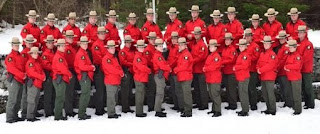
People have asked me for years, "why do you wear red jackets/parkas?" It's actually an interesting story, and it all started with a dog food company.

Some have suggested that our eastern sister group did it to imitate the New York State Forest Rangers, whom the Wilderness Search and Rescue Team, the unit I helped found in 1979, worked with extensively, and wore red Johnson Woolen Mills jackets. Yeah, but, no. When Wilderness started out, we gained a lot of expertise from the volunteer search and rescue (SAR) teams of Los Angeles County. At that time, both Sierra Designs and Woolrich (Which made/makes mountain parkas for LL Bean.) made 6-pocket "mountain parkas" out of a nylon/cotton blend called "60/40 Cloth" (or 65/35 for Woolrich) in a muted orange color. SAR teams all over the country wore them, including our friends in LACo, so we did too. However, for reasons that were never completely explained. orange 60/40 cloth disappeared from the marketplace sometime around 1982.

At roughly the same time, around 1984, the animal feed giant, Purina, started taking an interest in supporting SAR dog teams. Initially, they wanted to brand them nationally as "Purina Hi-Pro SAR Dogs," but that idea was quickly scrapped. Instead, they offered free dog food, mega-publicity, dog vests, and Woolrich mountain parkas for hundreds of teams nationwide. Since orange was no longer an option, and also since Purina's colors, coincidently, are Red and White, they struck a deal with Woolrich to provide free red, wool-lined jackets to SAR dog handlers, with "Purina Hi-Pro Search and Rescue Dogs" emblazoned in white screening over the left chest pocket. Not ones to look a gift horse (or dog) in the mouth, we took advantage of the offer and changed from "International Orange" (for those like me who still had their Sierra Designs parkas. Still have it, BTW.) and blaze orange, to Purina Red. It stuck.

Today, forty years later, most search and rescue teams have switched to either blaze orange or lime yellow, and most of the original mountain parka suppliers (LL Bean, Woolrich, Sierra Designs) don't make them anymore. Occasionally, Bean or Woolrich will bring them back for a time as a "legacy" item but most of the time you can only find them used, online. I've only ever worn out one Woolrich mountain parka; the one from Purina finally wore out at the elbows. I gave a blue one away, and I still have my original orange Woolrich SAR parka, with the patches still in place. Someday when Wilderness Search and Rescue gets a permanent home of their own back in Syracuse, it will hang there.


The NYS Forest Rangers (and some New England game wardens) still wear red jackets and parkas, and so do I. Originally, National Mountain Bike Patrollers wore yellow, green and gold jerseys, but in 2004, the national organization switched to red with a white cross, like most of the National Ski Patrol and in 2020, became an official part of the Ski Patrol system. After 26 years as a ranger, and 20 years wearing red in the volunteer ski and trail patrol, it has become part of my identity. A number of years ago, my wife bought me a brilliant red wool Filson Mackinaw for Christmas. It has been my "good" coat since then, although I've found that I now wear it more frequently than just going to church on Sunday. I still have my second red Woolrich/LL Bean parka, which now has the insignia of the Backcountry Trail Patrol embroidered on the chest. The Patrol, like many mountain bike and ski patrols, switched to red patrol jackets in the 1990s and jerseys in 2004. I was able to grab another wool-lined red mountain parka in one of those aforementioned "legacy" sales, and a Loden green one as well. They are my "go-to" outerwear at least eight months of the year. They are the most comfortable, functional coats I own. I doubt I'll ever wear out the ones I have in my lifetime, but I still wish that Woolrich or LL Bean would bring them back.  Like the red field jackets of the forest rangers, the red parkas of ski patrols across the country and the scarlet dress uniform coats of the 
Maine and New
Hampshire game wardens, there is just something about the red coat that says, "legendary."


Monday, May 15, 2023

National Police Week


National Police Week

This week, National Police Week, is dedicated to honoring the brave men and women who selflessly serve and protect their communities everyday. National Police Week is always held during the week of May 15th after President John F. Kennedy, in 1961, declared May 15th as National Peace Officers Memorial Day.

National Peace Officers Memorial Day


In 1962, President Kennedy proclaimed May 15 as National Peace Officers Memorial Day and the calendar week in which May 15 falls, as National Police Week. Established by a joint resolution of Congress in 1962, National Police Week pays special recognition to those law enforcement officers who have lost their lives in the line of duty for the safety and protection of others. Remembering Michael Staples (USFS, Chippewa N.F.), Kristine Fairbanks (USFS), Jason Crisp (USFS), Margaret Anderson (NPS), Ryan Weltman (NPS, from MN), and Kristopher Eggle (NPS) and all Law Enforcement Officers from all agencies who have given their lives in the line of duty.


Thursday, April 20, 2023

National Volunteer Week 2023: Discover the Forest With Us!


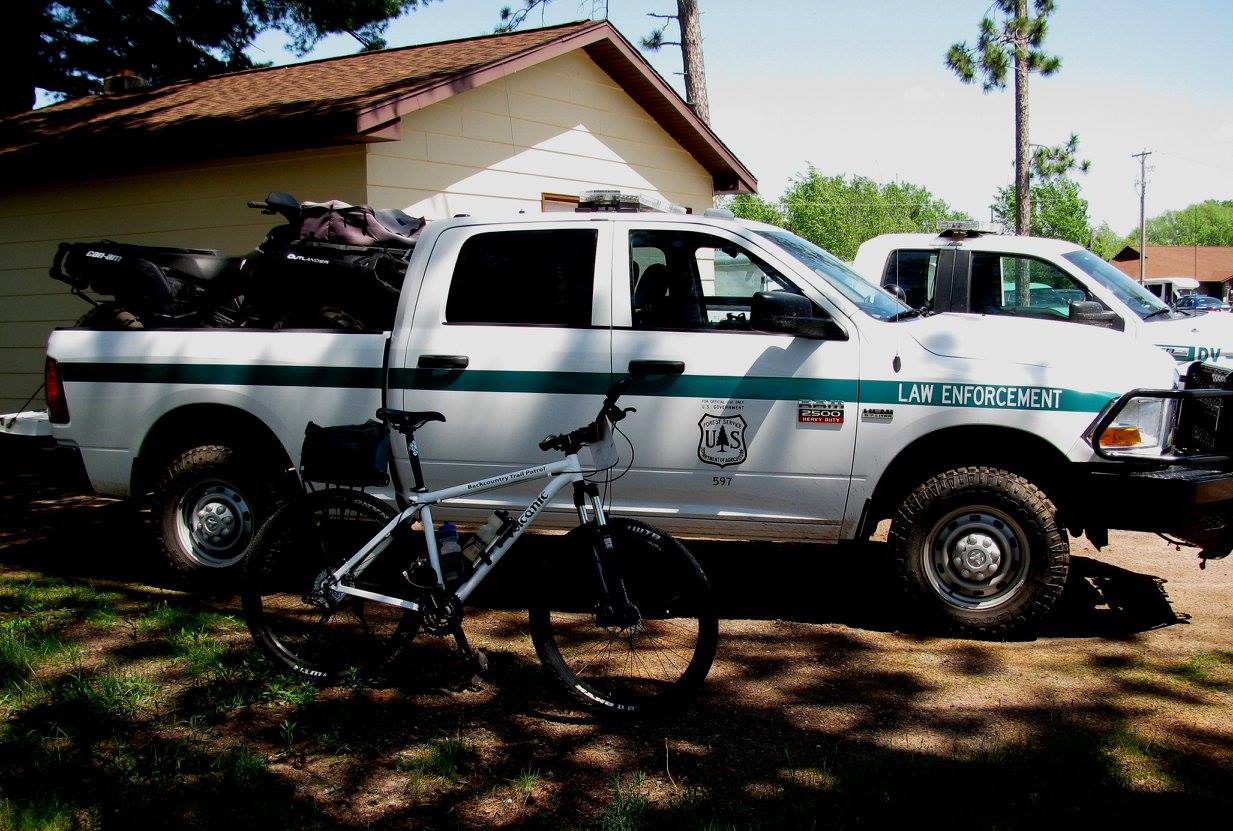
The Backcountry Trail Patrol Association, is a not-for-profit organization formed in 1996 as the North-Central Mountain Bike Patrol (NCMBP), which provides the U.S. Forest Service, Isanti County (MN) County Parks and other requesting agencies with volunteer manpower dedicated to protecting trail users and forest resources through service and backcountry safety education. The primary role of the Backcountry Patrol to serve as "Ambassadors to the Forest". The Patrol also assists by providing first aid/medical support at events related to and taking part on park and forest lands.

Mountain Bike Patrol volunteers patrol many of the Chequamegon Area Mountain Bike Association trails on the National Forest. Originally created as a program of the NCMBP, the Backcountry Patrol initially started in 1999 by helping to develop, promote, and patrol the Simpson Creek Trails on the Chippewa National Forest in north-central Minnesota. It incorporated as a separate entity in 2003, and assumed the non-event related functions of NCMBP later that year. Over time, the patrol also took on the event coverage roles of NCMBP as well.


Patrol members count the number of visitors, check for hazardous conditions, and educate, assist and inform all trail users. They also perform light trail maintenance, pick up trash and are available to provide first aid/medical and basic mechanical assistance to any forest visitor. In the winter season, these activities may be done using fat-bikes (mountain bikes with 4-inch or wider tires). snowshoes or cross-country skis.

Volunteer with BTPA! 

Chances are you’ve run into some of our Volunteer Patrol members in their bright red jerseys on the trail, but did you know that you could become a volunteer yourself? We are recruiting volunteers for this year and we have a late start on training because of all the snow this winter.

Members of the Mountain Bike Unit patrol team are a dedicated group of men and women who not only enjoy the activity of mountain biking, but also possess a desire to proactively promote awareness and responsible trail use for hikers, cyclists, and equestrians on the Chequamegon-Nicolet National Forest Great Divide District and Isanti County Parks

At its most basic, a trail patrol volunteer has a responsibility to schedule a minimum of eight hours of patrol each month between Memorial Day and the Chequamegon Mountain Bike Festival in mid-September. his may be done on the trails, or as a part of event coverage. During any given patrol, they may be called upon to perform a wide variety of duties; from supplying directions and offering maps and information, to giving basic first aid, to encouraging or exacting compliance with the  rules and regulations — even contacting and coordinating the resources needed to respond to emergency situations that may arise.


The patrol is not law enforcement, but they do work in partnership and communication with the authorized law enforcement agencies and as such are responsible for observing and recognizing any acts that may constitute a potential health hazard to the safety of forest resources and visitors.

For more information on patrol membership, contact any patrol member or email "BACKOUNTRY (at) TRAILPATROL.ORG"